YouTube Video Analysis: A Guide for UGC Campaigns


Many teams doing youtube video analysis stop at reporting. They know which video pulled the most views, but not which opening line held attention, which creator framing produced qualified clicks, or which product angle led to installs and purchases.
For UGC and influencer campaigns, that is a measurement failure, not a minor reporting gap.
YouTube is crowded enough that surface metrics break fast. A video can rack up reach and still be a weak asset if it attracts the wrong viewer, loses them before the core message lands, or drives cheap clicks that do not convert. In high-volume creator programs, the job is not to find one winner. The job is to spot repeatable patterns across a large batch of videos, separate luck from signal, and decide what should be briefed, edited, scaled, or cut.
That changes how analysis should work.
A single creator might use YouTube analytics to improve channel growth. An agency, brand team, or app marketer reviewing hundreds or thousands of creator assets needs a different system. The analysis has to connect creative decisions to business outcomes, reduce false positives, and show which combinations of hook, message, format, creator fit, and audience intent produce profitable results.
That is the standard worth using. Views are only useful when they help explain revenue, retention, or lower acquisition costs.
Table of Contents
- Why Your Current YouTube Video Analysis Is Incomplete
- The Performance Metrics That Actually Matter for UGC
- A Framework for Manual Video Analysis
- Scaling Your Analysis From 10 Videos to 1000
- Turning Analytical Insights Into Better Creative
- Connecting Video Performance to Campaign ROI
Why Your Current YouTube Video Analysis Is Incomplete
Most campaign reports still center on views, likes, and maybe comments. Those metrics aren't useless, but they rarely answer the question the buyer cares about: which creative decisions are worth repeating across the next batch of videos?
A founder running a mobile app campaign usually sees a familiar pattern. One creator gets strong reach. Another gets weaker reach but better user quality. A third has an average result on YouTube but ends up producing the strongest paid asset once the clip gets reused elsewhere. If your analysis stops inside one channel dashboard, you miss the point.
The biggest blind spot is that most tools treat YouTube as a silo. They show how a video performed on YouTube itself, but they don't answer whether a video style predicts downstream conversion or cross-platform success. That gap is especially important for app marketers and UGC agencies because a creator who gets attention on YouTube doesn't automatically drive installs or purchases elsewhere. The need for cross-channel performance attribution is highlighted in research on YouTube strategy gaps and single-platform validation.
What vanity metrics hide
A high-view video can still be a bad campaign asset if the wrong audience clicked, dropped early, or never acted on the CTA. On the other hand, a video with modest reach can become a useful template if it consistently holds attention and explains the product clearly.
That changes how you should read performance:
- Views tell you distribution: They show that YouTube gave the video a chance.
- Engagement can show resonance: Comments and likes may help flag audience reaction.
- Creative pattern analysis shows effective patterns: This helps you learn what to brief again.
Practical rule: In campaign work, don't ask "Which video won?" Ask "What pattern can we reproduce across creators without breaking performance?"
The unit of analysis is not the video
At scale, the video is only one data point. The essential unit is the pattern behind the video. That includes the hook type, creator persona, opening shot, thumbnail style, promise, pacing, proof element, and CTA structure.
That is why standard youtube video analysis often feels incomplete. It reports outcomes without classifying inputs. If you don't tag inputs, you can't separate luck from repeatable creative signal.
The Performance Metrics That Actually Matter for UGC
In UGC campaign analysis, three metrics do most of the heavy lifting: CTR, retention, and watch time. Everything else is secondary until these are stable. If those three are weak, the asset usually fails before it has any chance to influence lift, clicks, or downstream conversions.
For campaign teams reviewing dozens or hundreds of creator assets, the job is not to admire isolated winners. The job is to sort performance into two questions. Did the packaging earn the click? Did the video hold attention long enough to move the viewer toward action?
CTR shows whether the packaging did its job
Click-through rate is the first filter because it measures whether the video package earned curiosity from the right audience. On UGC campaigns, that usually comes down to a few repeatable inputs: a clear claim, a thumbnail that shows the product or result, and a title that names the problem or payoff fast.
A high CTR is useful, but only in context. I have seen creator assets pull strong clicks because the thumbnail is surprising or the claim is broad, then lose efficiency because the audience was wrong for the offer. That matters at scale. A misleading hook does not just hurt one video. It pollutes your pattern analysis and pushes teams to brief more of the wrong creative.
Use CTR to review packaging patterns such as:
- benefit-first vs curiosity-first titles
- creator face vs product-first thumbnails
- specific use case vs broad lifestyle framing
Retention shows whether the promise held up
Once someone clicks, retention becomes the sharper signal. It shows whether the opening, pacing, proof, and explanation were strong enough to keep attention. For UGC, weak creative usually gets exposed fast. Long intros, delayed product reveals, soft claims without proof, and repeated points all show up as early audience drop-off.
HubSpot's overview of YouTube analytics and retention behavior is useful here because it reinforces a practical point: shorter videos tend to retain a larger share of viewers, while longer formats need stronger structure to hold attention. For campaign analysis, that means you should judge retention by format and intent, not by one flat benchmark across every creator video.
The practical read is simple. If retention drops early across multiple creators, the issue is usually the brief, the hook structure, or the first proof point. If retention holds longer on a small subset, study what those creators did in the first 15 to 30 seconds and tag it.
Watch time shows distribution potential
Watch time matters because YouTube rewards videos that keep people on the platform. In campaign work, I use it less as a vanity outcome and more as a scaling signal. A video with healthy watch time has a better chance of earning more distribution, which lowers the pressure on paid support and improves the odds that a strong asset keeps compounding.
Watch time also helps separate two common situations:
| Metric | What it tells you | What to do with it |
|---|---|---|
| CTR | The package earned attention | Test title and thumbnail patterns across creators |
| Audience retention | The video delivered on the initial promise | Fix opening structure, proof, pacing, and clarity |
| Watch time | The asset sustained enough value to keep earning reach | Prioritize formats and creator styles that can scale distribution |
One pattern matters here. Some videos get clicked but do not hold attention. Others start with modest CTR, then build strong watch time because the audience fit and creative structure are better. For UGC campaigns, the second type is often more valuable because it is easier to improve packaging than to fix weak substance.
CTR gets the test. Retention and watch time decide whether the asset is worth scaling.
What to ignore until these metrics are stable
Campaign teams often spend too much time on likes, comments, and surface-level engagement before fixing the core failure point. Those signals can help with qualitative review, but they rarely explain why one creator format produces efficient conversions and another burns budget.
Prioritize analysis in this order:
- CTR: Did the package attract the right viewer?
- Early retention: Did the first section deliver value fast enough?
- Watch time: Did the full structure hold attention well enough to earn more reach?
- Engagement and CTA response: Useful after the core viewing pattern is healthy
That order keeps analysis tied to business outcomes. If you review UGC at scale, the goal is not just better YouTube reporting. The goal is to find creative patterns that keep earning attention, hold it, and translate into lower acquisition costs across creators and campaigns.
A Framework for Manual Video Analysis
Before automating anything, review a small batch manually. This forces the team to agree on what "good" looks like. If analysts can't classify ten videos consistently, software won't fix the underlying confusion.

Use a fixed review sequence
Use the same timestamps and questions every time. That removes a lot of subjective drift.
A simple review flow for an app promo video looks like this:
- Open the thumbnail and title
- Is the promise clear?
- Is the claim specific or generic?
- Would the right user click this?
- Watch the opening
- Does the first part show the problem, payoff, or result quickly?
- Does the creator talk about themselves before talking about the viewer?
- Is there friction before value appears?
- Scrub forward
- By the early middle of the video, can you tell what the app does?
- Is there visual proof, demo footage, or a credible use case?
- Does the creator repeat the same point instead of advancing the story?
- Check the ending
- Is the CTA clear?
- Does it ask for one action?
- Does the CTA fit the stage of awareness?
This manual process matters because it exposes failure modes fast. A lot of underperforming UGC doesn't fail because the creator is weak. It fails because the brief asked for too much setup and not enough payoff.
A simple review template
Use a short checklist rather than freeform notes. Freeform notes create messy data and make cross-video comparison harder.
| Review field | What to record |
|---|---|
| Hook clarity | Yes / No |
| Problem shown early | Yes / No |
| Value proposition clear | Yes / No |
| Proof element present | Screen demo / verbal claim / testimonial / none |
| Pacing | Tight / uneven / slow |
| CTA strength | Low / medium / high |
| Best moment | Write one short note |
| Drop-off risk | Write one short note |
Don't over-score too early. Binary labels often produce better analysis than fake precision.
After ten to twenty reviews, patterns become obvious. You start noticing that the strongest videos usually share a few traits. They name the problem quickly, show the product before overexplaining it, and avoid creator-centric intros that delay relevance.
That is the point of manual youtube video analysis. It trains your eye before you build a repeatable system around tags, reporting, and optimization.
Scaling Your Analysis From 10 Videos to 1000
At campaign scale, bad analysis gets expensive fast.
A team can review 10 videos by hand and still keep the story straight. Once that turns into 1,000 assets across creators, offers, markets, and flight dates, the failure point is no longer effort. It is system design. If tags are inconsistent, naming conventions drift, and performance data lives in five places, the team cannot tell whether a winning video won because of the hook, the creator, the offer, the audience, or simple timing.
That is the gap between review and operational analysis. Review helps you judge a video. Operational analysis helps you decide where to put the next $50,000 in creator spend.
Where manual analysis breaks
Volume is the obvious problem, but it is not the only one. The deeper issue is comparability. One strategist writes "strong product demo." Another writes "clear walkthrough." A third tags the same asset as "screen-recording UGC." All three may be right, and the dataset is still useless for trend analysis.
Context breaks teams next. A format that performs with a trusted niche creator can fail with a broad-reach lifestyle creator, even under the same brief. As noted earlier, outlier-video research focused on contextual fit supports the same practical lesson campaign teams learn the hard way. Pattern matching without creator and audience context leads to bad creative decisions.
Retrieval is the last failure point. Teams often remember the conclusion and lose the evidence. Someone recalls that side-by-side comparison videos drove stronger click quality, but no one can pull every asset with that format, compare retention and post-click performance, and test whether the pattern held across markets.
What scaled analysis needs to produce
Scaled analysis needs to answer allocation questions.
Which creator styles produce efficient conversions, not just cheap views? Which hooks improve hold rate but attract low-intent traffic? Which proof formats lift click-through and still preserve conversion rate after the landing page? Those are the questions that matter in UGC and influencer programs where creative decisions change media efficiency.
A useful system should let your team:
- Store performance data in one dataset: Views, watch behavior, clicks, conversions, spend, and publish context.
- Tag creative consistently: Hook style, product visibility, proof type, offer framing, CTA type, creator archetype.
- Compare fair cohorts: Same market, similar audience, same offer, similar distribution conditions.
- Spot repeatable patterns: Trends that show up across enough assets to justify a creative change.
- Connect video traits to business outcomes: Not just engagement, but qualified traffic, CPA, ROAS, or revenue where tracking exists.
That last point is where many teams fall short. A video can post strong watch time and still be a poor campaign asset if it attracts curiosity without purchase intent. I have seen creators produce impressive top-of-funnel numbers with weak commercial value because the hook entertained the right audience for YouTube, but the wrong audience for the offer.
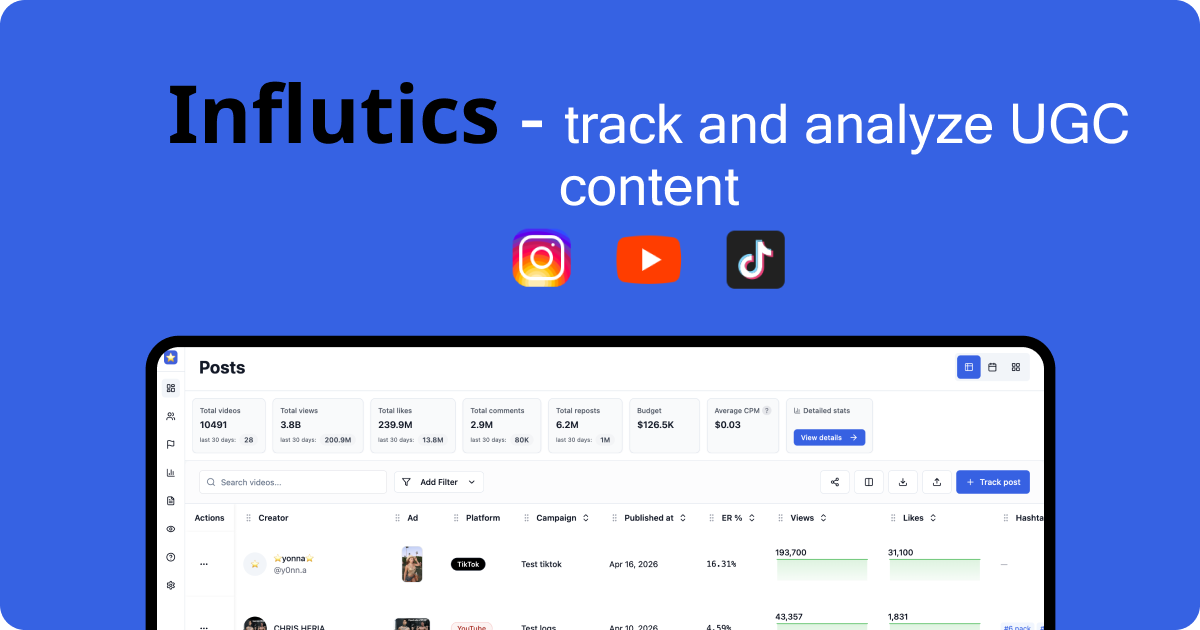
Platform support becomes necessary once the library gets large. Teams running UGC across repeated campaign flights need one place to standardize tags, pull creator-level comparisons, and tie content performance back to campaign outcomes. Influtics is one example of a platform used for tracking UGC content, creator analytics, performance, and ROI measurement across campaigns.

The goal is not a generic rule like "problem-solution hooks win." The goal is a usable rule with constraints. Problem-solution hooks may win for cold audiences in SaaS. Creator confession-style hooks may work better for beauty. Screen-demo openings may drive better conversion quality for product-led tools, even if their view curves look less impressive on the surface.
That level of specificity protects budget.
Budget gets wasted when teams copy the outlier and ignore the conditions that made it work.
Turning Analytical Insights Into Better Creative
Analysis is only useful when it changes the brief. If the team reviews videos, identifies the same friction points, and still sends creators vague instructions next round, nothing improves.

Example one fixing the promise mismatch
A common pattern looks like this. The thumbnail and title promise a direct result, but the video opens with backstory. The audience clicked for an outcome and got context instead.
The fix isn't complicated. Rewrite the creative brief so the first lines do one of these jobs immediately:
- State the pain: Show the problem in user language.
- Show the result: Lead with the before-and-after outcome.
- Show the product in use: Let the viewer understand the mechanism fast.
If retention drops whenever creators use long intros, change the brief. Require the core value proposition to appear early. Remove mandatory branding from the opening unless the creator can integrate it naturally into the hook.
Example two tightening thumbnail decisions
Thumbnail work is one of the easiest places to turn analysis into repeatable action. According to analysis of 93,421 videos from the top 100 YouTubers, effective thumbnail patterns include 0-3 words, high-contrast colors such as black or dark gray, and expressive faces, with A/B testing done directly in YouTube Studio to compare click-through rates across variants, as described in this YouTube thumbnail testing methodology.
That leads to a much stronger operating model than "make it pop."
Use thumbnail insights like this:
| Insight from review | Change to the brief |
|---|---|
| Text-heavy thumbnails underperform | Limit thumbnails to minimal text |
| Face-led thumbnails get stronger initial response | Ask creators for at least one expressive face option |
| Mixed design styles create noisy results | Standardize a few tested thumbnail templates |
| Teams change thumbnails without clean comparison | Run controlled A/B tests in YouTube Studio |
The important part is the methodology, not just the design opinion. Teams often tweak thumbnails after launch, then treat any later movement as proof that the new version worked. Without a direct comparison process, that conclusion is shaky.
Good creative teams don't "refresh" thumbnails blindly. They test variants and read the CTR in context.
The same principle applies to hooks, pacing, and CTAs. Once you know what breaks performance, the next creative brief should make that mistake harder to repeat.
Connecting Video Performance to Campaign ROI
At some point, every campaign conversation lands on the same question. Did these videos make money, lower acquisition cost, or improve media efficiency?
That is where youtube video analysis has to leave the content team and become part of campaign measurement. A video isn't valuable because it held attention. It's valuable because that attention translated into some business outcome.
Build one measurement chain
The simplest model is also the most useful. Connect each video, or each content pattern, to a chain of outcomes:
creative input -> YouTube performance -> click quality -> downstream conversion
That doesn't require a perfect attribution system on day one. It requires consistency. If you can map creators, video formats, hooks, and offers to post-click behavior, you can start making budget decisions on something stronger than intuition.
Use a working model like this:
- Creative layer: Hook style, creator angle, thumbnail pattern, CTA type
- Platform layer: CTR, watch quality, retention trend
- Business layer: Landing page response, install quality, purchase intent, or another campaign KPI
Many teams still struggle in this area. Most analysis stacks stop at the YouTube layer and never connect the content pattern to what happened next. That gap matters because cross-platform and downstream behavior often determine whether a creator is worth scaling.
Use YouTube data to make budget decisions
A useful ROI discussion usually sounds less glamorous and more operational than people expect.
Pause or reduce spend when a creator consistently gets attention but delivers weak post-click outcomes. Increase testing when a content format repeatedly produces strong viewing quality and cleaner downstream traffic. Keep separate scorecards for creators who are strong on organic YouTube versus creators whose footage performs better once repurposed into paid placements.
The point isn't to force every asset into one universal metric. The point is to stop treating all views as equal.
When teams do this well, YouTube analytics become a decision layer, not just a reporting layer. You stop asking who got the most reach and start asking which content style deserves more production, more editing support, and more paid amplification.
Ready to track and analyze all your UGC content in one place? Join Influtics to see which creators and content formats outperform across your campaigns.